The rapid growth of AI and ML workloads is reshaping enterprise infrastructure architecture. As demands increase, technical teams must accelerate model development, operate at scale, and manage infrastructure risk while maintaining control and efficiency.
Lambda’s infrastructure helps AI research and development teams to maximize their resources by providing access to the latest GPU technology. Lambda’s platform improves both technical and financial efficiency through customized AI/ML workload solutions and cost optimization features. Use Lambda for predictable training runs, datasets that must comply with data-sovereignty requirements, and bursty inference that needs elastic scale.
An enterprise-grade plan to deploy multi-cloud AI
Multi‑cloud for AI isn’t a philosophy; it’s an engineering response to GPU capacity risk, data‑residency constraints, and interconnect economics. Lambda provides dedicated GPU clusters, managed Kubernetes with native GPU and InfiniBand support, an S3‑compatible data plane, and first-party GPU telemetry for real-time observability and optimization. This lets you place training and inference where policy and latency dictate, not just where capacity is available.
This blog post examines how Lambda’s infrastructure enables seamless multi-cloud deployments, the tools and frameworks that support these solutions, and the resulting benefits for AI/ML workloads.
Single cloud limitations: know your risks
Modern AI/ML teams share a common mandate: ship models faster, remain agile, and mitigate infrastructure risk without compromising control, efficiency, or security. Teams choose multi-cloud to de-risk GPU capacity, meet data residency and sovereignty requirements, optimize interconnect and egress costs, and diversify their accelerator roadmaps.
Relying on a single cloud can simplify a first launch, but it quickly creates limitations:
- Vendor lock-in: limits your ability to adopt new hardware, optimize costs, or integrate emerging accelerators and open-source tools.
- Resource bottlenecks: scarce GPUs result in inconsistent access to compute, storage, and network resources, making them unreliable for on-demand or scale-out AI/ML workloads.
- Cost inflexibility: commitment-based pricing locks organizations into long-term spending, reducing their ability to optimize across vendors or generations of hardware.
- Complex compliance and data residency: single-provider footprints may not align with evolving data sovereignty, cross-border transfer, or workload isolation requirements
Facing these constraints, enterprises are shifting to distributed, interoperable infrastructure, gaining resilience, cost agility, and the freedom to scale production AI wherever it runs best.
Unlock AI compute and mitigate risks with multi-cloud
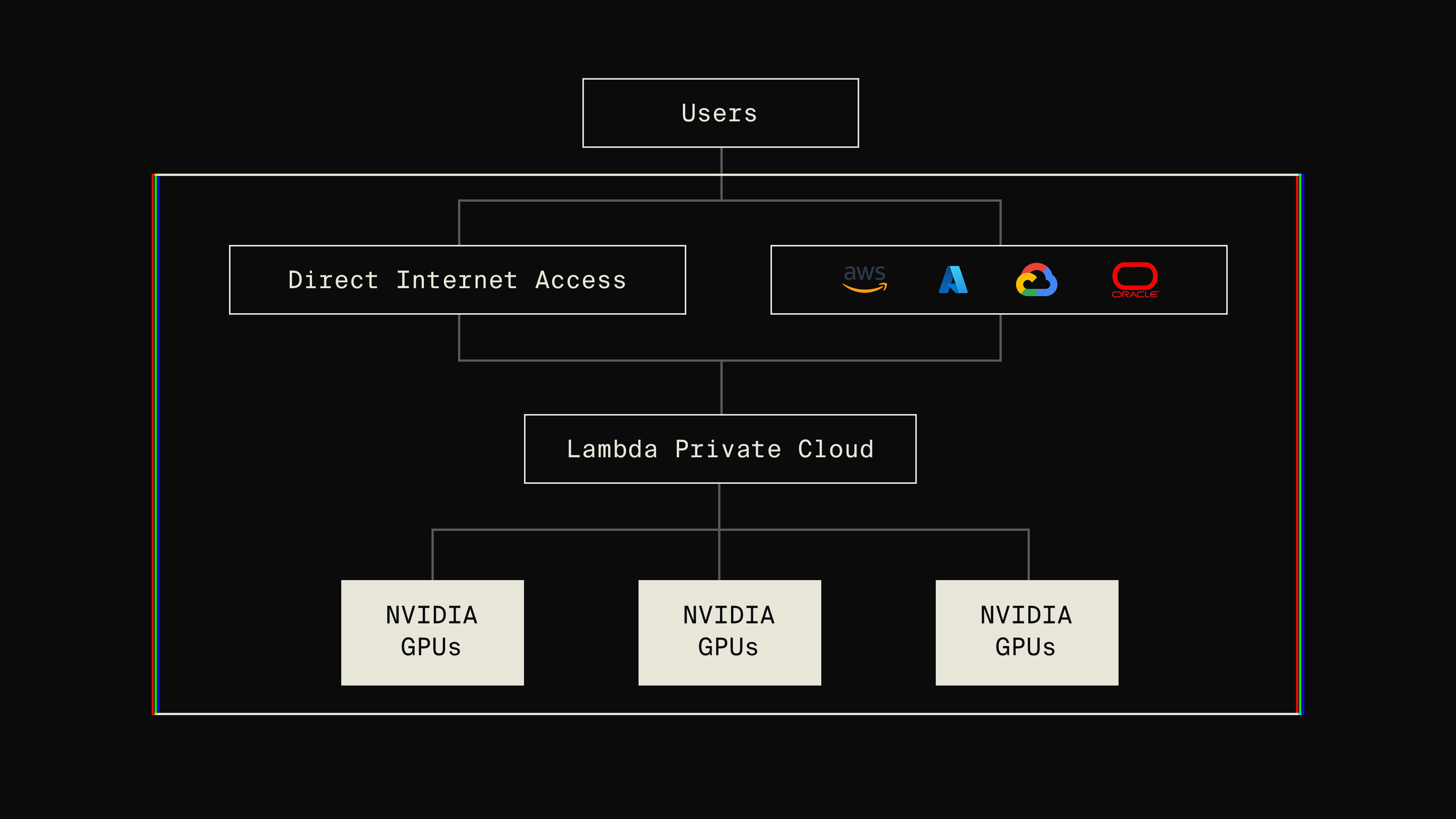 Lambda’s AI Cloud is interoperable by design, enabling seamless operations across AWS, Google Cloud, Azure, and OCI. By supporting open standards, Lambda lets you tap additional GPU capacity, optimize costs, and meet specific compliance or data-residency requirements in each region.
- Secured incremental AI capacity: Physically isolated, bare-metal NVIDIA GPU servers on the latest NVIDIA architectures for high-density training and inference.
- Cloud interconnects: Integrate Lambda with your clouds via AWS Direct Connect, Google Cloud Interconnect, OCI FastConnect, and Azure ExpressRoute.
- Zero data-transfer fees: Move data in and out of Lambda at no additional cost, unlike major cloud providers that charge fees for ingress and egress. This enables organizations to transfer data between platforms, streamlining multi-cloud workflows seamlessly.
- S3-compatible storage: pipelines can access training data and model artifacts across all supported platforms. Native support for S3 APIs ensures seamless data movement between Lambda, AWS, Google Cloud Storage, and Azure Blob Storage via S3-compatible gateways, so pipelines can access training data and model artifacts across all supported platforms.
- Kubernetes-native orchestration: Self-managed or Lambda-managed Kubernetes to run CNCF-conformant stacks such as KubeFlow, MLFlow, and KubeRay.
- Enterprise observability: Lambda’s observability stack is built on Prometheus, Grafana, Alertmanager, and open-source exporters. It supports secure outbound alerts and offers customizable rules with example configurations. All metrics and alert processing remain in-cluster, while only customer-defined notifications are sent externally.
Best practices for implementing multi-cloud AI
Designing efficient AI infrastructure requires more than just raw GPU power; it also involves orchestrating across multiple environments. Once you identify workload bottlenecks and GPU scaling limits, define the orchestration model for hybrid and multi-cloud workflows. Lambda enables connecting purpose-built GPU clusters to Oracle, Azure, AWS, and Google Cloud, forming a unified, high-performance hybrid architecture.
- Infrastructure provisioning
- Establish secure cloud interconnects via AWS Direct Connect, Google Cloud Interconnect, Oracle FastConnect, or Azure ExpressRoute for lower latency and reduced egress costs.
- Use Lambda’s S3-compatible file storage adapter to enable unified data and artifact access across clouds.
- Automate Lambda, Azure, AWS, OCI, and GCP infrastructure with Ansible.
- Cluster management
- Deploy quickly and easily RKE2-based Kubernetes clusters (self-managed or Lambda-managed), using CNCF-standard AI/ML tools such as Kubeflow, MLflow, KubeRay, and more.
- Job scheduling and scaling
- Utilize Ray, Kubeflow, or Torch to schedule dynamically and scale AI/ML jobs.
- Support elastic, multi-node deep learning with TorchElastic.
- Workflow automation
- Orchestrate machine learning pipelines via Apache Airflow or Argo, enabling model training on Lambda infrastructure.
- Configurability & DevOps
- Manage builds, secrets, and CI/CD pipelines using Ansible, ArgoCD, GitOps, or Flux.
- Monitoring, optimization & governance
- Leverage the lambda-guest-agent to collect system metrics, such as GPU and VRAM utilization, and view them on the Cloud dashboard.
- Integrate observability tools like Prometheus, Grafana, or Datadog.
- Monitor GPU usage, I/O, and performance metrics in real-time.
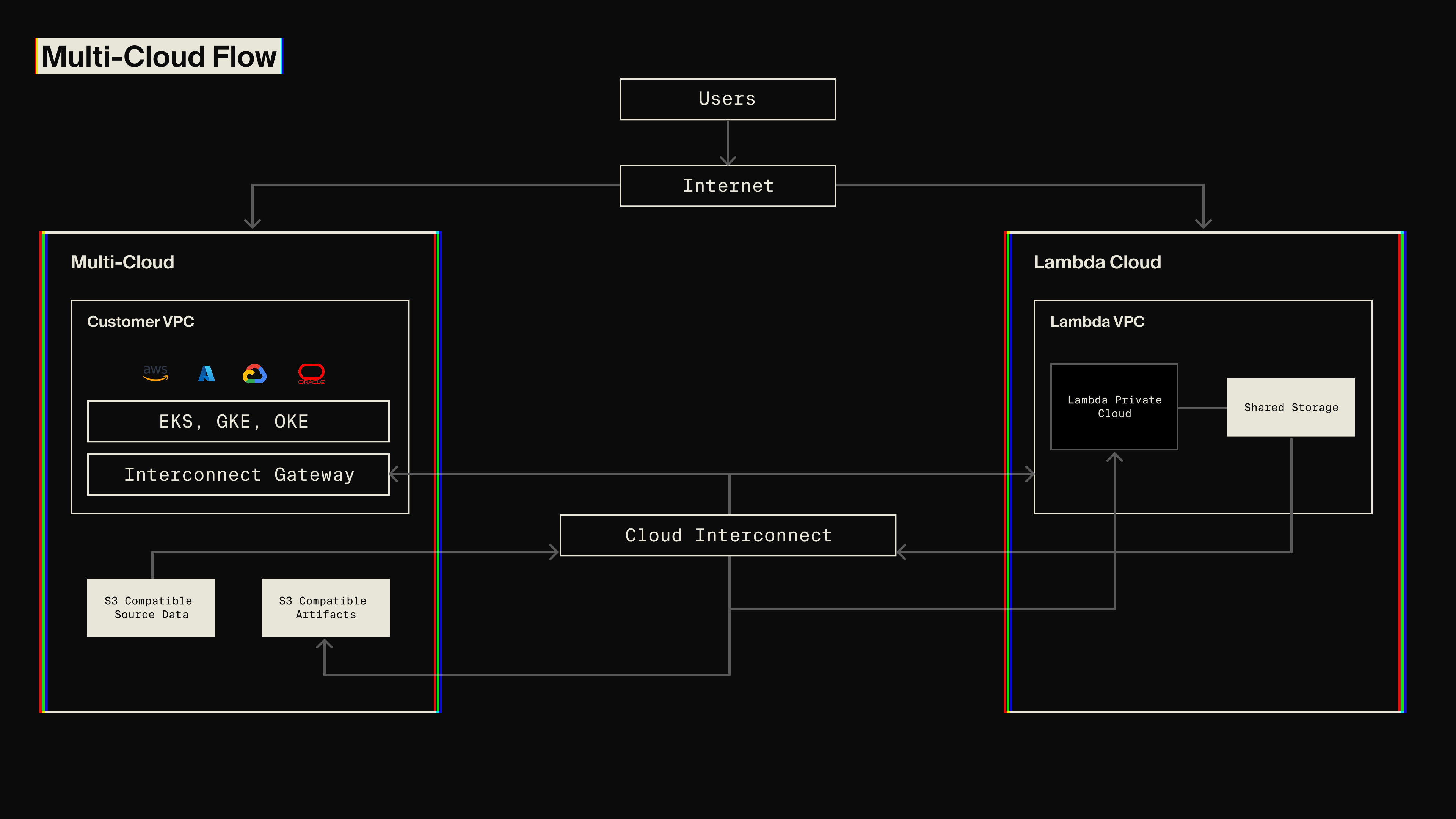
Lambda pairs the latest NVIDIA GPUs with Kubernetes-native orchestration and a bring-your-own-stack model for multi-cloud AI workloads. The patterns above assume a Kubernetes control plane and a portable data layer (S3‑compatible object storage), relying on industry-standard, open-source CNCF tooling to maximize portability, observability, and policy-driven governance across clouds.
Lambda Superclusters as part of your multi-cloud AI infrastructure
Lambda Supercluster delivers dedicated, bare-metal Nvidia GPU clusters, low-latency networking, and high-throughput interconnects in physically isolated data centers. These environments enable teams to run latency-sensitive and data-intensive AI/ML workloads with predictable performance and comprehensive data locality, ensuring optimal performance and data utilization. Enterprises that incorporate Lambda into their multi-cloud architecture see benefits such as:
- Flexible, right-sized solutions for every AI journey: Run across multiple clouds, including on-premise, private, hybrid, or customized cloud environments.
- Unified storage and interoperability: Seamless S3-compatible storage eliminates data silos and simplifies pipeline integration across ecosystems.
- Comprehensive observability: Enterprise-grade monitoring and real-time metrics for proactive optimization and troubleshooting.
- End-to-end security: SOC 2 Type II certification, SSO login, and protection of sensitive workloads.
- Operational support: Industry-leading SLAs with 24/7 infrastructure monitoring, proactive incident response, and dedicated escalation channels to maintain uptime and velocity.
- Cost optimization and flexibility: Flexible pricing and efficient resource allocation as workloads scale, with no data ingress or egress fees.
- Co-engineering & embedded expert support: ML practitioners and infrastructure specialists work alongside your team to accelerate AI workloads, troubleshoot in real-time, and remove bottlenecks.
Lambda helps organizations overcome GPU shortages, reduce infrastructure risk, and drive AI/ML innovation with secure, scalable, and high-performance multi-cloud architectures.
What’s next
Lambda provides NVIDIA GPU-dense infrastructure, Kubernetes-native orchestration, and S3-compatible storage to run AI/ML workloads across multiple clouds. With secure interconnects, real-time observability, and cost-efficient data movement, teams can train and serve models at scale without vendor lock-in. This gives enterprises a reliable and flexible foundation for future AI growth.
Talk to our team to start building secure, scalable, multi-cloud AI/ML infrastructure with Lambda.