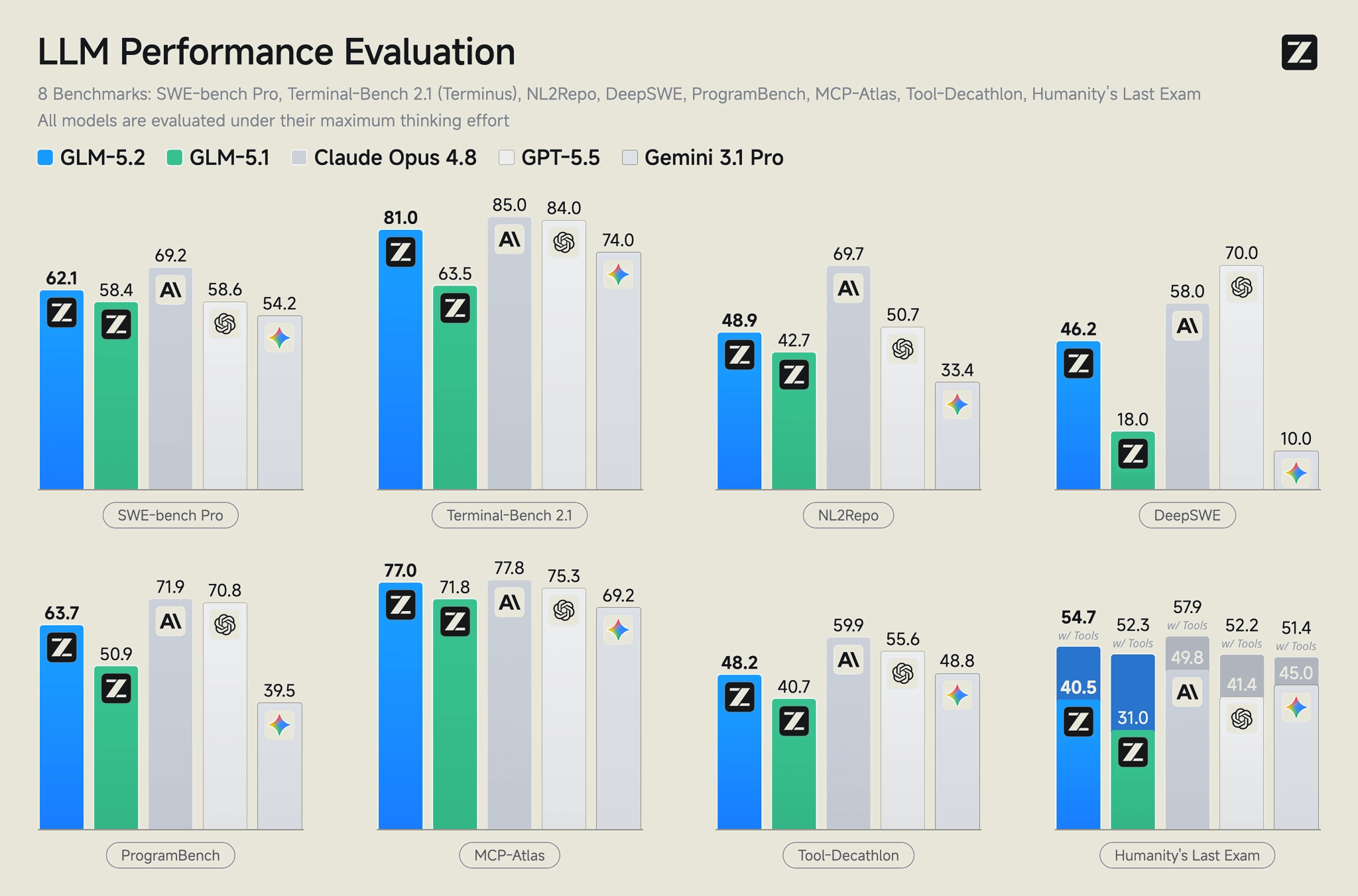
On June 16th, Z.ai released GLM 5.2, its latest flagship model. At the time of announcement, it advertised scores at or near Anthropic and OpenAI's models, and far ahead of GLM 5.1. In the world of usable, deployable, and reliable AI models, however, the benchmarks matter, but don’t paint the picture of how capable the model is in the real world. What happened next has turned the field on its head.
Many call it the "DeepSeek moment for agents."
GLM itself is the exact same architecture at 744 billion parameters. So large that most individuals can’t run it on their own hardware and must rely on cloud compute just to access it. With large models such as these, the usual pattern is that for a few days everyone gets excited, a few individuals run it on-premises and show how slow (or fast) it can run quantized, and then most people fall back into the cloud with models like Anthropic's Claude Opus and OpenAI’s GPT. More reputable sources reported not only that this model is the real deal, but also that experienced labs and industry leaders were replacing much of their workloads with GLM (and, a few weeks later, keeping it there after extensive testing).
The data
The first signs of change should be from the model hosts. Yuchen (MTS at Databricks) briefly discussed on X that they are seeing more corporations asking them to serve the model internally. Notably, an open-weight model allows you (the company) to modify the weights to be performant on your own tasks and needs internally. Combine this with (what many are claiming) as near-or-at Anthropic’s Claude Opus 4.8 levels of performance and a path to owning the stack while removing dependencies on closed-source proprietary models is starting to form.
This alone, though, isn’t enough to spark the start of a movement, as we've seen many strong models (both in performance and expectation) that fail to stick the landing well into everyday use-cases and workflows, which is why most people will see how they perform as drop-in replacements in workflows that rely on Claude Code or Codex. This time, an interesting trend began to form.
For many tasks, GLM 5.2 has exceeded what other open-source models have been capable of before, and more users are trusting it for more intensive operations. One such example is alphaXiv's autoresearch tool. It's an intensive pipeline and harness that takes recently published papers and reproduces and ablates their results. In their words: "GLM 5.2 is the first open weights model we've tried on our autoresearch pipeline that's proven capable for real research tasks." Another sign of this is that, typically, when we consider models and their harnesses, there are "tiers" to their intelligence levels and needs:
- The driver model: usually the strongest and most expensive model, responsible for understanding the user's goal, planning, maintaining global context, deciding what to delegate, reviewing results, and resolving ambiguity.
- The subagent model, a cheaper or more specialized model assigned to delegated tasks. It may handle implementation, investigation, test running, verification, refactoring, documentation, or domain-specific work.
- The worker or utility model, the cheapest/lightest model used for narrow, mechanical, or low-risk tasks such as summarization, classification, command-output digestion, or simple extraction.
In prior open-weight releases, many have tried to replace the driver and the subagent with an open-weight model, only to revert in a few weeks to one (or both) being closed-source models, while many open-weight models become the worker model. With GLM 5.2, we're seeing more labs report that while GLM cannot replace the driver, it comfortably serves as the subagent.
What's next
For a while, the idea of open-source models that are usable (and helpful) by a majority of software engineers has been one of "we'll get there soon, but it's just not quite there yet." GLM 5.2 represents this tipping point. The next GLM will be stronger. The other labs will race to catch up to its performance. But does this mean that everyone can run this on their own hardware and get off the cloud? No, not entirely.
To keep up with the workflows many are used to, models need to run relatively fast without sacrificing much performance (thanks to techniques like quantization). Even at the highest level, building a system that can handle GLM 5.2 unquantized costs in the hundreds of thousands of dollars (at the time of writing), and the throughput will still not match what hardware vendors and AI native clouds can offer.
There are efforts to make this more usable on-premises by trying to carefully remove certain capabilities from the model and weakening others (such as REAP), but this still leaves the typical user with a model that, while on paper, can do many capable things, is now only good at one particular task that they needed to solve in this moment. Sacrificing breadth for depth.
For now, serving a model like this at full quality takes real infrastructure: over a terabyte of VRAM, fast GPUs, and the economics to make it quick and affordable to access. That's the tradeoff. As open weights close the capability gap, the harder problem moves downstream, to whoever can serve them well. Intelligence becomes a commodity. The new bottleneck is the infrastructure that produces it.
Read more: how to deploy GLM 5.2 on Lambda